Database-to-API workflow
Turn existing data structures into organized REST endpoints without starting every API from a blank controller.
Dynamic REST API builder for existing databases and structured business data.
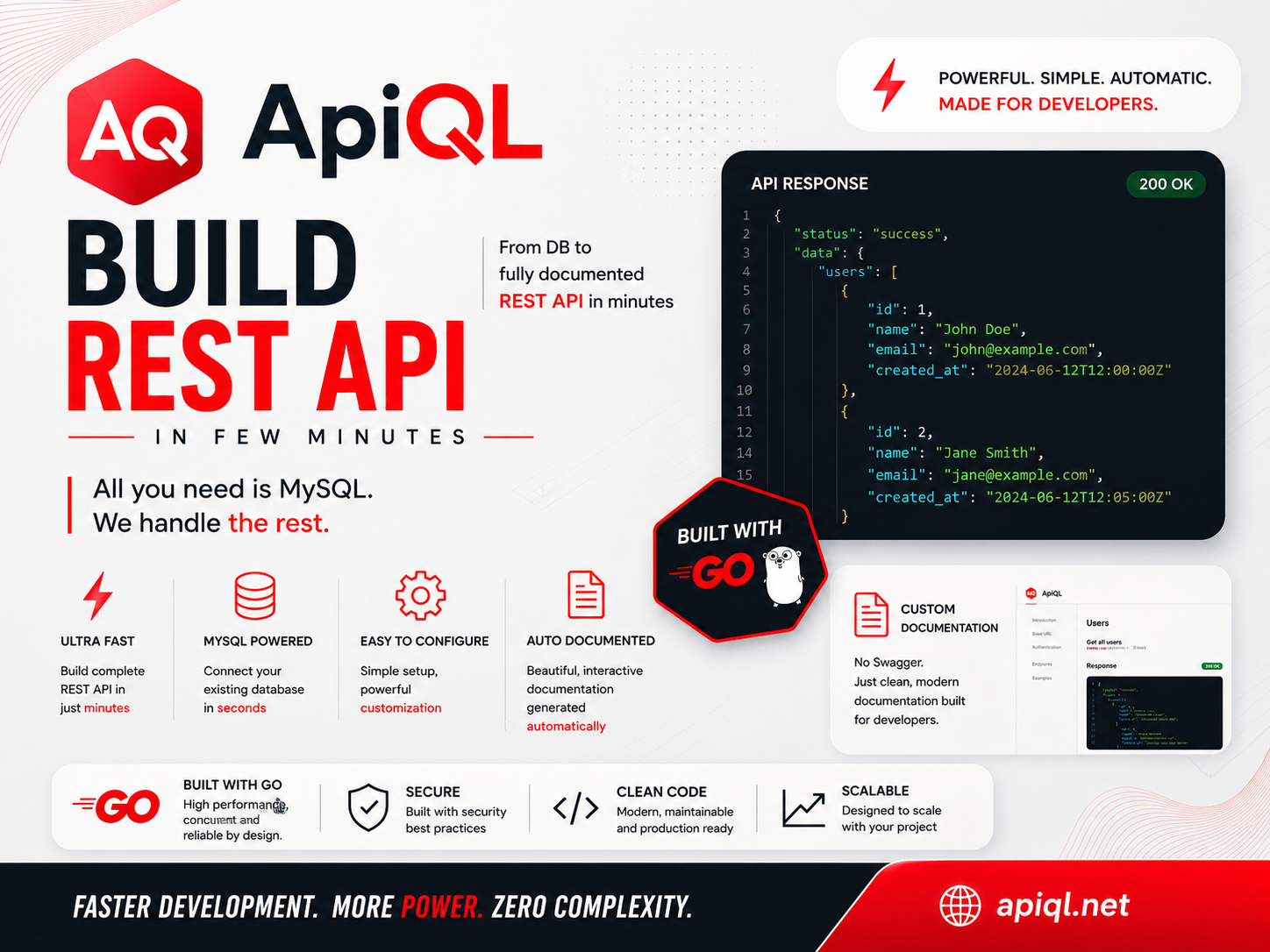
APIQL is an independent developer platform for creating REST API layers around existing database-backed systems. It focuses on predictable endpoints, clear documentation, token-controlled access, and faster integration delivery without rebuilding the same CRUD API foundation for every project.
Independent product
APIQL is an external developer product for teams that want to expose structured database data through a clean REST API without hand-building the same CRUD, routing, validation, and documentation layer again and again. It is designed around practical API delivery: connect a database, define controlled access, generate predictable endpoints, and give developers documentation they can actually use.
The product is especially useful when a project already has a MySQL-backed system, admin panel, CRM, inventory database, internal tool, or legacy app, but needs a modern API layer for integrations, dashboards, mobile apps, automation, or partner access.
Turn existing data structures into organized REST endpoints without starting every API from a blank controller.
Expose structured API actions with clean request and response patterns that are easier for developers to integrate.
APIQL focuses on clear endpoint documentation, examples, and request structure so consumers know how to call the API.
Token-based access and scoped configuration help keep generated endpoints useful without making the database public by default.
How it works
A project owner starts from an existing database-backed system and prepares the data source that should be exposed through APIQL.
Tables, resources, allowed actions, fields, and access rules are shaped into a controlled API layer instead of exposing everything blindly.
APIQL prepares REST-style endpoints with documentation and examples so developers can test calls and integrate faster.
The generated API can support dashboards, mobile apps, integrations, automation jobs, reporting tools, partner access, and internal workflows.
Use cases
Usage model
APIQL accounts, connected databases, generated APIs, tokens, documentation, and billing are managed directly on apiql.net.
AI-tools presents the product and links to it, but does not manage APIQL workspaces, projects, database credentials, or checkout.
APIQL is intended as an independent platform for building and documenting REST APIs around existing structured data.
Core scope available in the current product release.
Turn existing structured data into a controlled REST API layer without rebuilding every endpoint manually.
Create consistent request and response patterns for dashboards, mobile apps, integrations, and automation.
Generated API documentation and examples help consumers understand how to call each endpoint correctly.
Token-based access supports safer integration workflows and keeps API usage scoped to configured projects.